In progress and under consideration – Journal 4 – Jello or Fudge – what’s my consistency?
In Progress and Under Consideration is a reflective series prepared for Publishing 201 – the Publication of the Professional Self. This series is in part a fulfillment of a pre-discussed and agreed upon exchange of academic services and goods, and also a personal reflection on where I’m going and whatever it is I’m doing here.
I’ve referred to this site and to my professional presence as an extension of my practice. As something that should be consistent with the overall vision and message, It is thus something that has to be ‘on brand.’ But what does it really mean to consider myself as a brand?
Within the publishing environment, this consideration always returns to that Simon Sinek talk “How great leaders inspire action.” In it, Sinek discusses different technology companies and the value proposition that they use to drive consumer purchases. Purchases that Sinek describes as the result of those companies’ successful ability to communicate an authentic narrative or story, the “Why you do it.”
This consideration in and of itself is easy enough, I enjoy exploring how people tell stories, and my personal art practice focuses on how we can, or are limited in telling stories through text, sculptural or photographic means. Within my work practice, this focus on telling stories is in supporting initiatives that allow people to connect (say elections, or orientation programs) alongside initiatives that allow other people to share their stories (as curator and arts administrator).
Within the arts more broadly, the concept of the brand is also quite common in various distinct forms. Many museums now consider themselves as brands, controlling the kind of exhibits they plan, producing merchandize and commodifying a public image through goods and social media. Similarly, many museums are treated as brands by artists, who see them as institutions and markers to be added to a CV, signifiers of success and belonging within particular art environments.
On the other hand, one can consider artists as a brand. Something which has become an increasingly pertinent question as art markets and festivals become increasingly commercialized. Many artists are now inseparable from their brands. This can take the form of their name, imagery, or identity as is the case of Frida Kahlo and Pablo Picasso – two individuals whose names and likenesses have been used and adapted to sell just about anything from cars to waterbottles. On the other hand, there’s the visual brand of an artistic practice. Artists such as Barbara Kruger, Cindy Sherman, Jeff Koons, Anish Kapoor, Jeff Wall, or Catherine Opie are immediately recognizable in their work, and thus build upon a readily identifiable critical or visual aesthetic.
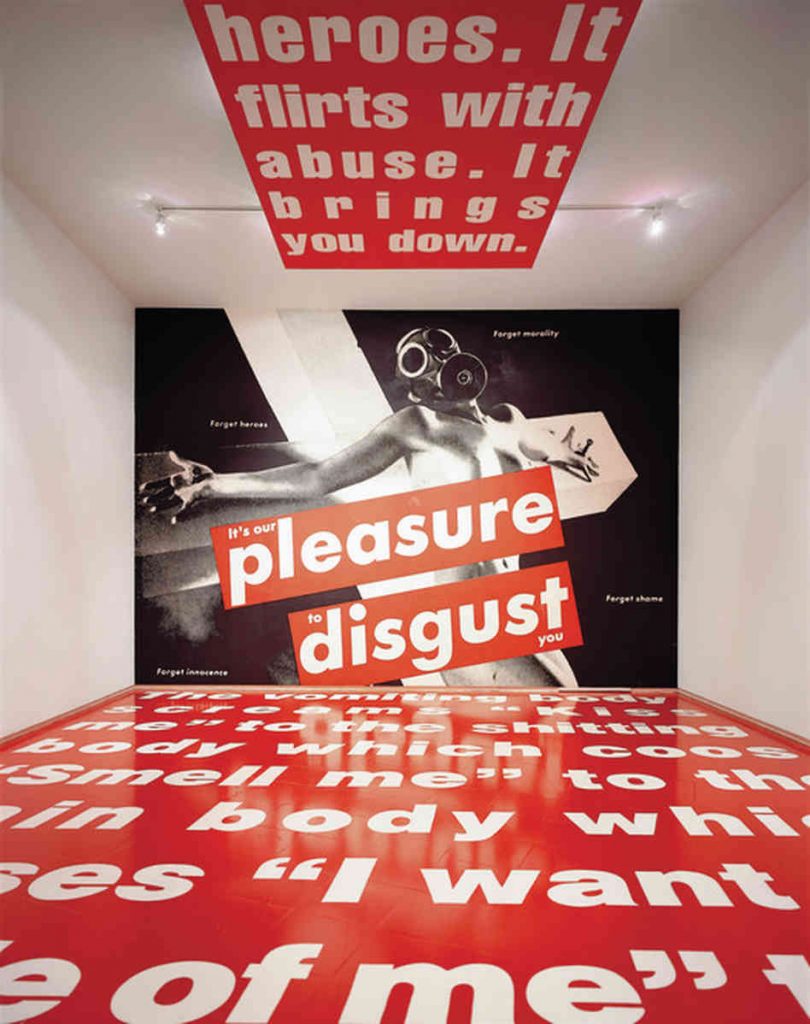
Untitled (It’s our pleasure to disgust you), Installation Shot at the Mary Boone Gallery (1991), Barbara Kruger, 1982
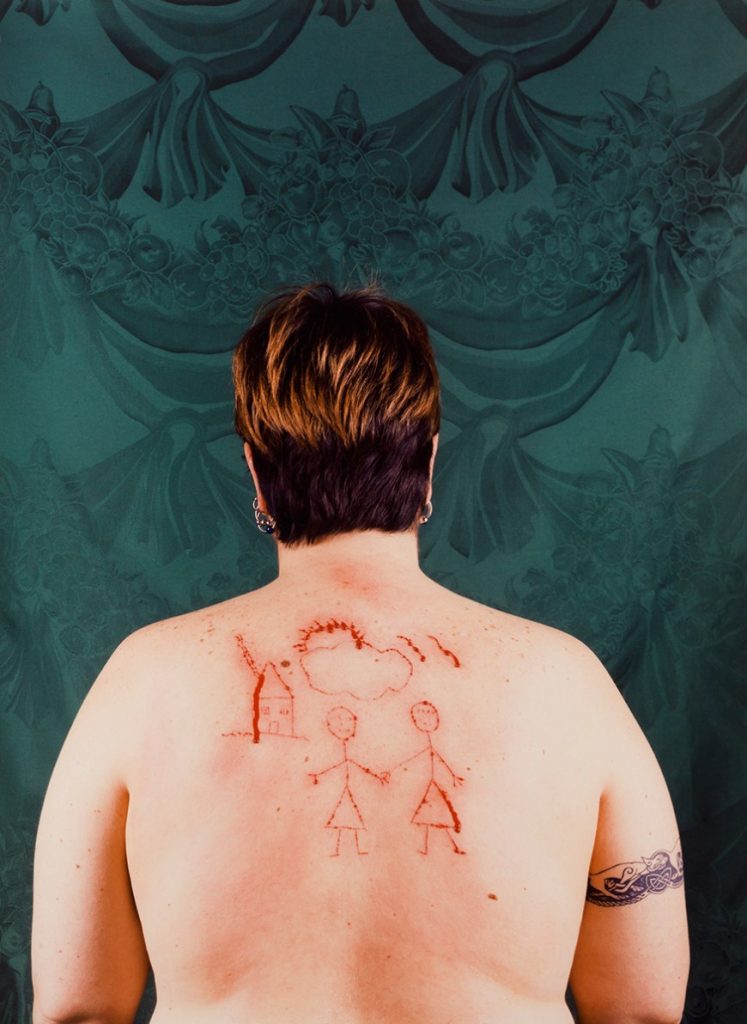
Self Portrait/Cutting, Catherine Opie, 1993
So the important question becomes how does a diverse practice like mine reconcile itself as a brand – particularly when there’s no unique aesthetic form that carries from work to work? Moreover, how is this ‘brand’ affected by my work experience, curatorial work, or if I go and get a job doing something else entirely (say working as a flight attendant as I almost did twice)?. This consideration is important not only as I try to reconcile these different issues onto a single digital platform, but also in how I frame it. The url of this site presents one such opportunity and point of tension here. There was after all considerable discussion around the benefits of using oscaralfonso.com vs os.alfonso.co, a url that amongst other things was predicated on .co as a branded business entity and positioned my art practice as a producer over solely an artist.
I’m also reminded of my friend and colleague Lauren Tsuyuki, who would always know a project was mine, even If I switched drastically between mediums. According to her, they were always thoroughly researched, very controlled, organized, and restrained into shape. Perhaps this is where some of my own internal consistency – and brand – kicks in. My projects are often simultaneously playful and dramatic, personal and ambiguous, controlled and also quite fun. So perhaps another important component of my brand then is perhaps in how I work. After all, earlier iterations of my artists’ statement focused on how I prefer working by hand, and though I have slowly moved more into a digital space through publication design, the fact remains that I prefer doing the work myself.
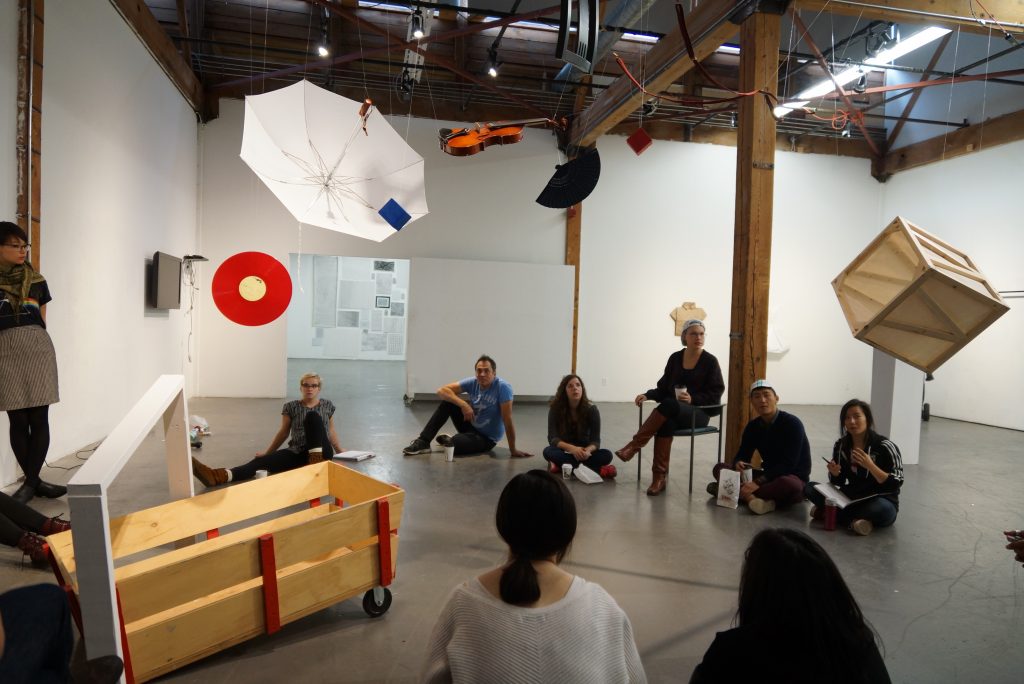
Object Theatre I, Installation Shot, Oscar Alfonso, 2014.
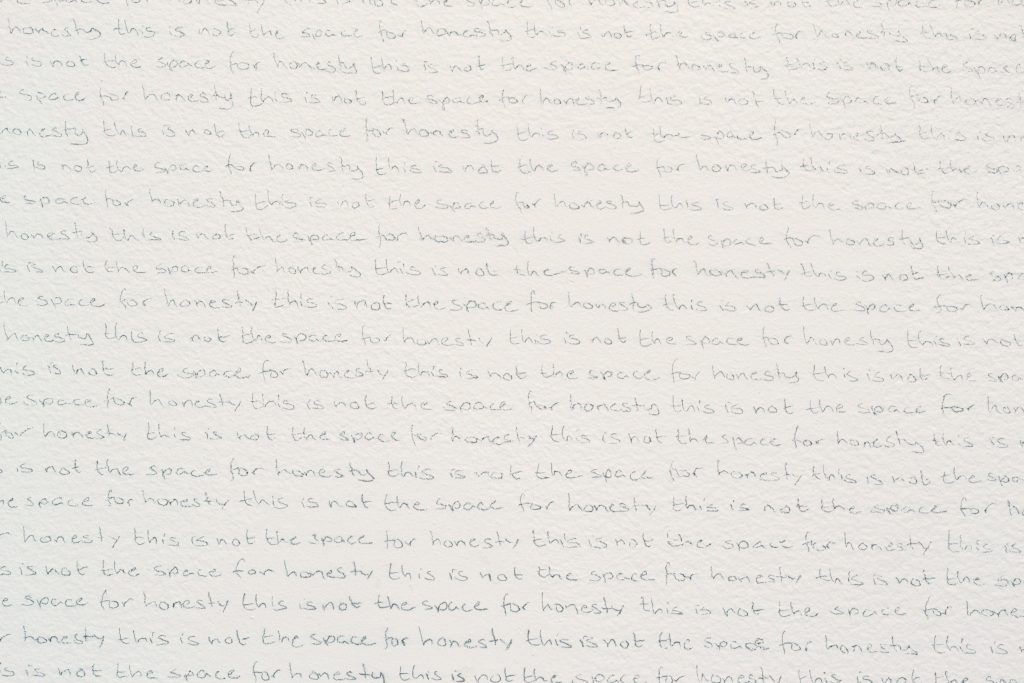
This is not the space for honesty, Detail, Oscar Alfonso, 2016.
When it comes to new areas of expertise that are necessary for a project, I prefer learning about a new skill and delving into a new field. This mode of working through a hands on approach is thus an important part of how I work, and of how I might position myself as a ‘brand.’ Some artists, such as Ian Wallace and Ken Lum, work in small studios and hire out for portions of the work (in their case with type and signage). Others, like Simon Fujiwara have a small staff of artists’ assistants that support them on projects, and then there’s others like Jeff Koons and Ai WeiWei who hire hundreds of people to commission work produced by the labour of others. Thus, I propose that my own personal interest in learning, and in hands on work for my projects, is an important part of how I work and of my brand proposition as an artist. This is much the same in my personal work experience in administration and event management where I always attempt to connect personally with the people I’m serving or working with, even if I’m ostensibly in charge of a project and ‘have better things to do,’ (which I don’t since people come first).
Which brings me back to my common reference to ‘internal consistency,’ I’ve frequently referred to my interests in a critically engaged artistic practice, and I think this is also an important consideration in the development of a ‘brand.’ Thus I should ascribe to work on projects and commissions which somehow add to the site or conversation, rather than simply act as artistic decoration. I’m reminded here of Simon Fujiwara, who spoke to our field-school class and mentioned a specific project in a closed Welsh Prison, where he was invited to work with other artists inside individual jail cells as part of some kind of corporate art-brand festival exercise (something he turned down) in the process of this undertaking he would have been neglecting the unique history of the site and of the people that passed through those cells. The Vancouver Mural festival presents another similarly complex opportunity. While from certain perspectives it may be an excellent community event and an opportunity for increased visibility, it nevertheless betrays the critically engaged artistic medium of muralism (specifically from 1920s Mexican muralism) which is socialist, politically informed, and engaged with the site and community.
Thus them, I propose that I will aim to provide an internally consistent practice and service, focused on telling stories and facilitating the telling of stories by others. A practice that is critically engaged and conscious of the specifics of the project and site, and in which I am involved in ideation, planning, and execution from the start to the end. My brand is thus a diverse one that is focused more on ideas and processes than aesthetics, and it is one that is playful and serious, personal, and ambiguous.